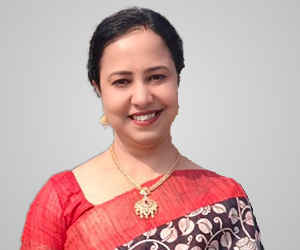
Debarati Mukherjee's work bridges life course epidemiology, neuroscience, and public health to improve maternal and child health in India. She is Lead and Professor-in-Charge of the PHFI-Centre for Developmental and Lifecourse Research (PHFI-CDLR), Public Health Foundation of India, and Professor at the Indian Institute of Public Health-Bengaluru, where she leads multidisciplinary teams working at the intersection of maternal health, early child development, mental health, and nutrition/psychosocial exposures.
Trained in cell, molecular, and developmental biology at Purdue University, USA, and subsequently in neurobiology at the National Centre for Biological Sciences (NCBS), Bengaluru, she brings a translational lens to public health research - advancing scalable digital tools for early cognitive assessment, cohort-based research on neurodevelopment, and now shifting focus to implementation research methods to strengthen health and education systems for women and children. Her current portfolio includes the ICMR-funded "Womb to World" study examining biological and psychosocial determinants of emotional and behavioural outcomes in infants, the COINCIDE project investigating nutritional, psychosocial, and environmental determinants of neurodevelopment and mental health in urban and rural Indian children, and contributions to several ICMR consortia on stillbirth, anaemia, gestational weight gain, and hypothyroidism. Her research is supported by major grants from the DBT/Wellcome Trust India Alliance, ICMR, and several global partners.
She is President of the DOHaD India Regional Society, Co-lead of the Karnataka Birth Cohorts Consortium, and Honorary Adjunct Faculty at the Institute of Public Health (IPH), Bengaluru. In 2026, she was selected into the prestigious WomenLift Health India Leadership Journey, a globally competitive programme dedicated to expanding the influence of mid-career women leaders in health. She is deeply committed to mentoring early-career and women researchers, and to building national capacity for life course research through data harmonisation across India's major birth cohorts.